










Digital Sufism: Naqshbandi Haqqani and the Transformation of Contemporary Ṭarīqa
Abstract
The rapid advancement of digital technology, shifting patterns of religiosity, and changing forms of religious authority have transformed how Muslims access, experience, and practice Sufism, compelling Sufi orders to adapt to contemporary contexts. This article examines the transformation of the Haqqani Naqshbandi Order in response to the dynamics of digital Sufism, spiritual practice, religious authority, and urban religiosity. The study employs an integrative literature review by analyzing academic publications indexed in Scopus, Sinta, and Google Scholar, together with relevant books and digital sources. The findings reveal that the Haqqani Naqshbandi Order recontextualizes classical Sufi teachings through digital platforms, simplified membership participation, and the promotion of mahabbah as a universal spiritual value. These transformations have fostered a socially adaptive model of Sufism capable of addressing urban life, globalization, and shifting religious authority. This article contributes by mapping the recontextualization of spiritual authority, religious practices, and communal engagement within the digital sphere
Keywords
Full Text:
PDFReferences
Al-Haqqani, S. N. A. (1980a). Mercy Oceans: The teachings of Mawlana ‘Abdullah al-Faizi ad-Daghestani.
Al-Haqqani, S. N. A. (1980b). Mercy Oceans: The Teachings of Sheikh Abdullah Ad-Daghistani An-Naqshbandi (book two).
Al-Haqqani, S. N. A. (2008). Love: Sufi Teachings and Spiritual Practices. SereSereS Editions.
Asbury, M. E. (2022). Naqshbandi Mujaddidi Mysticism in the West: The Case of Azad Rasool and His Heirs. Religions.
Asmarani, D., & Monica, S. (2023). Transnational Tariqa: The Expansion of Naqshbandī Haqqânî and the Fulfilment of Urban Spirituality. Ulul Albab: Jurnal Studi Islam, 24(2), 232–255. https://doi.org/10.18860/ua.v24i2.23630
Asyadily, M. H., Cahyandari, R., Firnanda, N. A., & Widyansyah, J. A. (2025). Implementasi Psikoterapi Zikir di Klinik Griya Sehat Syafaat 99: Perspektif Tasawuf, Teologi, dan Psikologi. JOUSIP: Journal of Sufism and Psychotherapy, 5(1), 1–16. https://doi.org/10.28918/jousip.v5i1.10922
Aulia, L. (2023). Praktik Zikir Tarekat Naqsyabandi Haqqani dalam Meningkatkan Ketenangan Jiwa. UIN Syarif Hidayatullah Jakarta.
Bottcher, A. (2006). Religious authority in transnational sufi networks: Shaykh Nāzim Al-Qubrusī Al-Haqqānī Al-Naqshbandī. Social, Economic and Political Studies of the Middle East and Asia, 100, 241–268. https://doi.org/10.1163/ej.9789004149496.i-310.68
Bruinessen, M. Van. (1996). Tarekat Naqsyabandiyah di Indonesia. Mizan.
Bruinessen, M. Van. (1998). Studies of sufism and the sufi orders in indonesia. Welt Des Islams, 38(2), 192–219. https://doi.org/10.1163/1570060981254813
Bruinessen, M. Van, & Howell, J. D. (2007). Sufism and the “Modern” in Islam. Western Sydney University.
Casanova, J. (1994). Public Religions in the Modern World. The University of Chicago Press.
Damrel, D. W. (2006). Aspects of the Naqshbandi-Haqqani order in North America. In R. Geaves & T. Gabriel (Eds.), Sufism in the West (pp. 115–126). Routledge. https://doi.org/Geaves, Ron Gabriel, Theodore
Davie, G. (2007). The Sociology of Religion. SAGE Publications.
Dickson, W. R. (2014). An American Sufism: The Naqshbandi-Haqqani Order as a Public Religion. Studies in Religion/Sciences Religieuses, 43(3), 411–424. https://doi.org/10.1177/0008429814538229
Dudoignon, S. A. (2020). Chapter 22 Cyber Sufism. In Sufi Institutions (pp. 405–414). Brill. https://doi.org/https://doi.org/10.1163/9789004392601_024
Estu, R. D. (2022). Eksistensi Tarekat Naqsyabandi Haqqani di Jakarta. Pegon: The International Journal of Islam Nusantara Civilization, 7(1), 137–149.
Gazali. (2015). Tarekat Naqsyabandi Haqqani Di Indonesia. Deepublish.
Hegazy, W. (2020). Cyber Sufis: Virtual Expressions of the American Muslim Experience (Islam in the Twenty‐First Century). CyberOrient, 14(2), 99–103. https://doi.org/10.1002/j.1804-3194.2020.tb00005.x
Hidayat, Z. (2022). Transformasi Sufism Into Digital Media: Eshaykh and Simplification of Tarekat Orthodoxy. Epistemé: Jurnal Pengembangan Ilmu Keislaman, 17(2), 197–223. https://doi.org/10.21274/epis.2022.17.2.197-223
Howell, J. D., & Bruinessen, M. Van. (2008). Sufisme dan “yang Modern.” In Urban Sufism. Rajawali Pers.
Husein, F., & Slama, M. (2018). Online piety and its discontent: revisiting Islamic anxieties on Indonesian social media. Indonesia and the Malay World, 46(134), 80–93. https://doi.org/10.1080/13639811.2018.1415056
Indonesia, N. H. (n.d.). Silsilah Keemasan. Yayasan Haqqani Indonesia.
Kabbani, M. H. (2004). The Naqshbandi Sufi tradition guidebook of daily practices and devotions.
Kabbani, S. M. H. (2015). Self-Purification and the State of Excellence: Encyclopedia of Islamic Doctrine ( terj. A. S. Rizal (Ed.)). Serambi.
Milani, M., Possamai, A., & Wajdi, F. (2017). Branding of Spiritual Authenticity and Nationalism in Transnational Sufism BT - Religions, Nations, and Transnationalism in Multiple Modernities (P. Michel, A. Possamai, & B. S. Turner (Eds.); pp. 197–220). Palgrave Macmillan US. https://doi.org/10.1057/978-1-137-58011-5_10
Nugroho, W. (2021). Sufism and Interreligious Dialogue: The Naqshbandi Haqqani Sufi Order in Indonesia. Teosofia: Indonesian Journal of Islamic Mysticism, 10(1), 111–126. https://doi.org/10.21580/tos.v10i1.8459
Nurani, S. (2020). Urban Sufism And Transformation Of Islamic Culture In Millenial Society. Religia: Jurnal Ilmu-Ilmu Keislaman, 21(2), 156–169. https://doi.org/10.28918/religia.v21i2.1508
Piraino, F. (2016). Between real and virtual communities: Sufism in Western societies and the Naqshbandi Haqqani case. Social Compass, 63(1), 93–108. https://doi.org/10.1177/0037768615606619
Profil Yayasan Haqqani Indonesia. (2009). Naqshbandi Haqqani Indonesia.
Putra, J. S., & Abdurahman, D. (2024). Tarekat Naqsyabandi Haqqani: Peranan dan Pengaruhnya terhadap Masyarakat Kontemporer Kota Padang. Kontekstualita: Jurnal Sosial Keagamaan, 38(02), 115–130. https://doi.org/10.30631/38.02.115-130
Putra, J. S., & Karali, N. (2025). Contemporary Expressions of Sufism : The Naqshbandi Haqqani Order in the Urban Context of Padang. DINIKA: Academic Journal of Islamic Studies, 10(2), 185–216. https://doi.org/10.22515/dinika.v10i2.11238
Ridwan, A., Sururin, S., & Zamhari, A. (2025). Embodied Dzikir: Pengalaman Spiritual Penari Whirling dalam Tarekat Naqsyabandiyah Haqqani Rabbani di Indonesia. Empirisme: Jurnal Pemikiran Dan Kebudayaan Islam, 34(01), 189–208. https://doi.org/10.30762/empirisma.v34i1.2998
Rozehnal, R. (2019). Cyber Sufis: Virtual Expressions of the American Muslim Experience (Islam in the Twenty-First Century). Oneworld Academic.
Schimmel, A. (1975). Mystical Dimension of Islam. The University of Carolina Press.
Shadiqin, S. I. (2018). Tasawuf di Era Syariat: Tipologi Adaptasi dan Transformasi Gerakan Tarekat dalam Masyarakat Aceh Kontemporer. Substantia: Jurnal Ilmu-Ilmu Ushuluddin, 20(1), 66. https://doi.org/10.22373/substantia.v20i1.3406
Shadiqin, S. I., Wahyudi, M. A., Alfiatunnur, A., & Jamil, S. (2024). Rumi Concept of Love : The Path to Interfaith Harmony and Peace. 13(2), 157–173. https://doi.org/10.24260/alalbab.v13i2.2986
Sirriyeh, E. (2013). Sufis and Ant-Sufis: The Defence, Rethinking and Rejectio of Sufism in the Modern World. Routledge.
Stjernholm, S. (2011). Lovers of Muhammad : A Study of Naqshbandi-Haqqani Sufis in the Twenty-First Century. Centre for Theology and Religious Studies.
Sulistiana, S. (2008). Berdiri dan Berkembangnya Tarekat Naqsybandi Haqqani di Jakarta. UIN Syarif Hidayatullah Jakarta.
Weismann, I. (2007). The Naqshbaniyya: Orthodoxy and Activism in a Worldwide Sufi Tradition. Routledge.
Whittemore, R., & Knafl, K. (2005). The integrative review: updated methodology. Journal of Advanced Nursing, 52(5), 546–553. https://doi.org/https://doi.org/10.1111/j.1365-2648.2005.03621.x
DOI: http://dx.doi.org/10.21043/esoterik.v12i1.35660
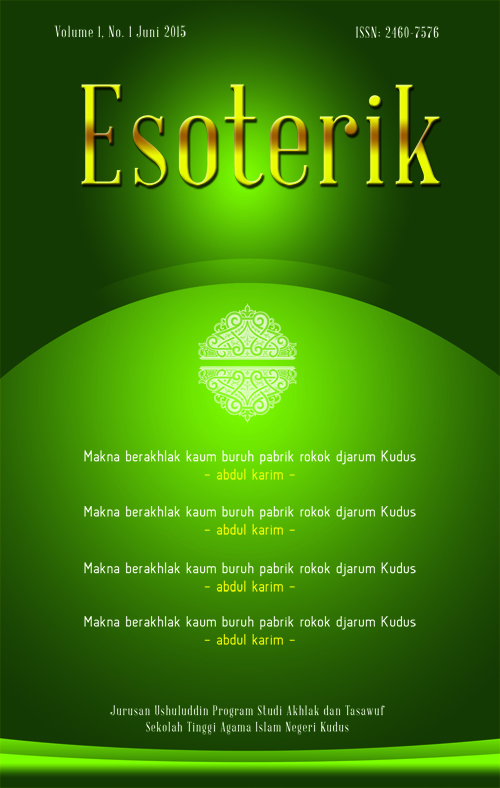
Esoterik : Jurnal Akhlak dan Tasawuf
Published by Program Studi Tasawuf dan Psikoterapi, Fakultas Ushuluddin collaborated with Konsorsium Tasawuf dan Psikoterapi Indonesia (Kotaterapi), Institut Agama Islam Negeri Kudus
Jl. Conge Ngembalrejo Bae Kudus Po Box. 51
Phone: +62291-432677
Website: http://journal.stainkudus.ac.id/index.php/esoterik
Email: [email protected]/[email protected]
ISSN 2460-7576 (print) | EISSN 2502-8847 (online)

Esoterik: Jurnal Akhlak dan Tasawuf by Program Studi Tasawuf dan Psikoterapi Fakultas Ushuluddin Institut Agama Islam Negeri Kudus is licensed under a Creative Commons Attribution-ShareAlike 4.0 International License.