









Banjar Sufism: The Relationship between Fiqh and Sufism in the Works of Sheikh Muhammad Arsyad Al-Banjari
Abstract
This study aims to examine in greater depth the relationship between Islamic jurisprudence (fiqh) and Sufism (taṣawwuf) in the thought of Syekh Muhammad Arsyad al-Banjari, with two main objectives. First, it explores how he responded to the dynamics of the fiqh–taṣawwuf relationship in his time, particularly within the context of tensions between legalistic and spiritual approaches. Second, it analyzes how the ontological and epistemological relationship between fiqh and taṣawwuf is constructed within his intellectual framework. Utilizing a qualitative, text-based method with analytical and hermeneutical approaches, the research focuses on two of his key works: Kanz al-Maʿrifah and Fatḥ al-Raḥmān. The findings reveal, first, that Syekh Arsyad responded to the prevailing tension between jurisprudential formalism and mystical excesses by formulating a balanced position that affirms the necessity of both dimensions in Islamic practice. He positioned fiqh as a necessary structure for regulating external behavior, while emphasizing taṣawwuf as a means for spiritual refinement grounded in that structure. Second, the study shows that Syekh Arsyad envisioned an integrated religious life based on an ontological unity between fiqh and taṣawwuf, while maintaining their epistemological distinction. For him, fiqh and taṣawwuf must not be conflated, yet cannot be separated. Taṣawwuf provides the inner spirit and depth of Islamic practice, while fiqh offers the normative framework that safeguards taṣawwuf from deviation. This model reflects a coherent synthesis in which both disciplines complement and complete each other, contributing to a holistic and balanced vision of Islamic piety rooted in the local epistemology of the Malay-Indonesian Muslim world.
Keywords
Full Text:
PDFReferences
Al-Banjari, M. A. (n.d.). Kanz al-Ma’rifah. Dār al-Syākirīn.
Al-Banjari, M. A. (1983). Tuḥfat al-Rāghibīn (M. Siddiq (ed.)).
Al-Banjari, M. A. (1985). Fatḥ al-Rahmān (A. Syukur (ed.)). Hasanu.
Al-Banjari, M. A. (2009). Madzhab Ahlu Sunnah wal Jamaah. In Pemikiran-pemikiran Syeh Muhammad Arsyad al Banjari dalam Bidang Tauhid dan Taṣawwuf. Comdes Kalimantan.
Asmaran, A., Yaqin, H., & Mahmud, M. (2022). Transmisi Ilmu Taṣawwuf Tuan Guru di Kalimantan Selatan. Al Qalam: Jurnal Ilmiah Keagamaan Dan Kemasyarakatan, 16(2), 510. https://doi.org/10.35931/aq.v16i2.896
Azra, A. (2004). The origins of Islamic reformism in Southeast Asia: Networks of Malay-Indonesian and Middle Eastern “Ulamā” in the seventeenth and eighteenth centuries. Allen & Unwin University of Hawai’i Press.
Azra, A. (2013). Jaringan ulama: Timur Tengah dan kepulauan Nusantara abad XVII & XVIII. Kencana.
Daudi, A. (1996). Maulana Syekh Muhammad Arsyad Al-Banjari (Tuan Haji Besar). Madrasah Sullam al-Ulum.
Dickson, W. R. (2022). Sufism and Shari‘a: Contextualizing Contemporary Sufi Expressions. Religions, 13(5), 449. https://doi.org/10.3390/rel13050449
Fathurahman, O. (2008). Tarekat Syattariyah di Minangkabau. Prenadamedia Group.
Haq, Z. U. (2023). Modern Western Thought and Islamic Reformism: Intellectual Challenges, Prior Discourse, and Future Prospects. Religions, 14(3), 308. https://doi.org/10.3390/rel14030308
Hockings, P., & Tashakori, F. (2024). Islamic Societies Are Encountering Modernity: An Introduction. Visual Anthropology, 37(5), 403–409. https://doi.org/10.1080/08949468.2024.2411177
Iqbal, M. (2021). Arsyad al-Banjari’s Approaches to Rationality : Argumentation and Sharia. Université de Lille.
Iqbal, M. (2022). Arsyad al-Banjari: A Banjarese Shāfiʿī Scholar (pp. 111–120). https://doi.org/10.1007/978-3-030-91676-3_4
Iqbal, M., & Rahman, S. (2021). Arsyad Al-Banjari’s Dialectical Model for Integrating Indonesian Traditional Uses into Islamic Law. Argumentation, 35(1), 73–99. https://doi.org/10.1007/s10503-020-09526-y
Majid, N. (2008). Islam: Doktrin dan Peradaban. Paramadina.
Mujiburrahman. (2013). Taṣawwuf di Masyarakat Banjar : Kesinambungan dan Perubahan Tradisi Keagamaan. Kanz Philosophia : A Journal for Islamic Philosophy and Mysticism, 3(2), 153. https://doi.org/10.20871/kpjipm.v3i2.46
Mujiburrahman, M., Rusydi, M., & Iqbal, M. (2024). Relationship Between Theological & Sufistic Thought of Sheikh Muhammad Arsyad Al-Banjari: Examining the Book of Hidâyah Al-Râshidîn Al-Mustarsyidîn, the Book of Ushuluddin and Kanz Al-Makrifah. Anterior Jurnal, 23(3), 71–82. https://doi.org/10.33084/anterior.v23i3.7785
Nur, S. (2013). Kritik Terhadap Pemikiran Taṣawwuf Al-Raniri. Kanz Philosophia : A Journal for Islamic Philosophy and Mysticism, 3(2), 137. https://doi.org/10.20871/kpjipm.v3i2.45
Putra, A. E. (2013). Taṣawwuf Dalam Pandangan Muhammad Arsyad Al-Banjari. 8(2), 91–102.
Rahman, F. (1979). Islam. The University of Chicago Press.
Refani, M. (2019). Pemikiran taṣawwuf Syekh Muhammad Arsyad al Banjari dalam Risalah Kanzul Ma`rifah. Universitas Indonesia.
Rosyadi, I. (2019). Gerakan Pembaruan Islam Syekh Nuruddin Ar-Raniry di Tanah Aceh: Pertikaian Antara Neo-Sufisme dan Sufisme-Filosofis. 1–13.
Saleh, A. F. (2010). Tarekat Sammaniyah di Kabupaten Banjar. Comdes Kalimantan.
Schacht, J. (1982). An Introduction to Islamic Law. Clarendon Press.
Steenbrink, K. A. (1984). Beberapa Aspek tentang Islam di Indonesia Abad ke19. Bulan Bintang.
Trimingham, J. S. (1971). The Sufi orders in Islam. Oxford at the Clarendon Press.
van Bruinessen, M. (2012). Kitab Kuning, Pesantren, dan Tarekat. Gading Publishing.
Wardani. (2004). Sufisme Banjar: Telaah atas Risalah Kanz al-Ma’rifah. Kandil, 4(2), 57–73.
Zarkasyi, M. (2014). Pemikiran Taṣawwuf Muh Arsyad al-Banjari dan Pengaruhnya di Masyarakat Kalimantan Selatan. ISLAMICA: Jurnal Studi Keislaman, 3(1), 76. https://doi.org/10.15642/islamica.2008.3.1.76-95
DOI: http://dx.doi.org/10.21043/esoterik.v11i1.31865
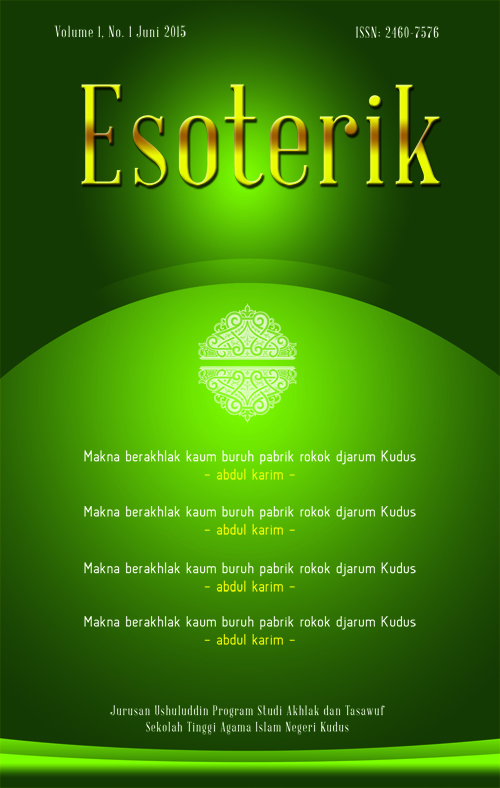
Esoterik : Jurnal Akhlak dan Tasawuf
Published by Program Studi Tasawuf dan Psikoterapi, Fakultas Ushuluddin collaborated with Konsorsium Tasawuf dan Psikoterapi Indonesia (Kotaterapi), Institut Agama Islam Negeri Kudus
Jl. Conge Ngembalrejo Bae Kudus Po Box. 51
Phone: +62291-432677
Website: http://journal.stainkudus.ac.id/index.php/esoterik
Email: [email protected]/[email protected]
ISSN 2460-7576 (print) | EISSN 2502-8847 (online)

Esoterik: Jurnal Akhlak dan Tasawuf by Program Studi Tasawuf dan Psikoterapi Fakultas Ushuluddin Institut Agama Islam Negeri Kudus is licensed under a Creative Commons Attribution-ShareAlike 4.0 International License.