

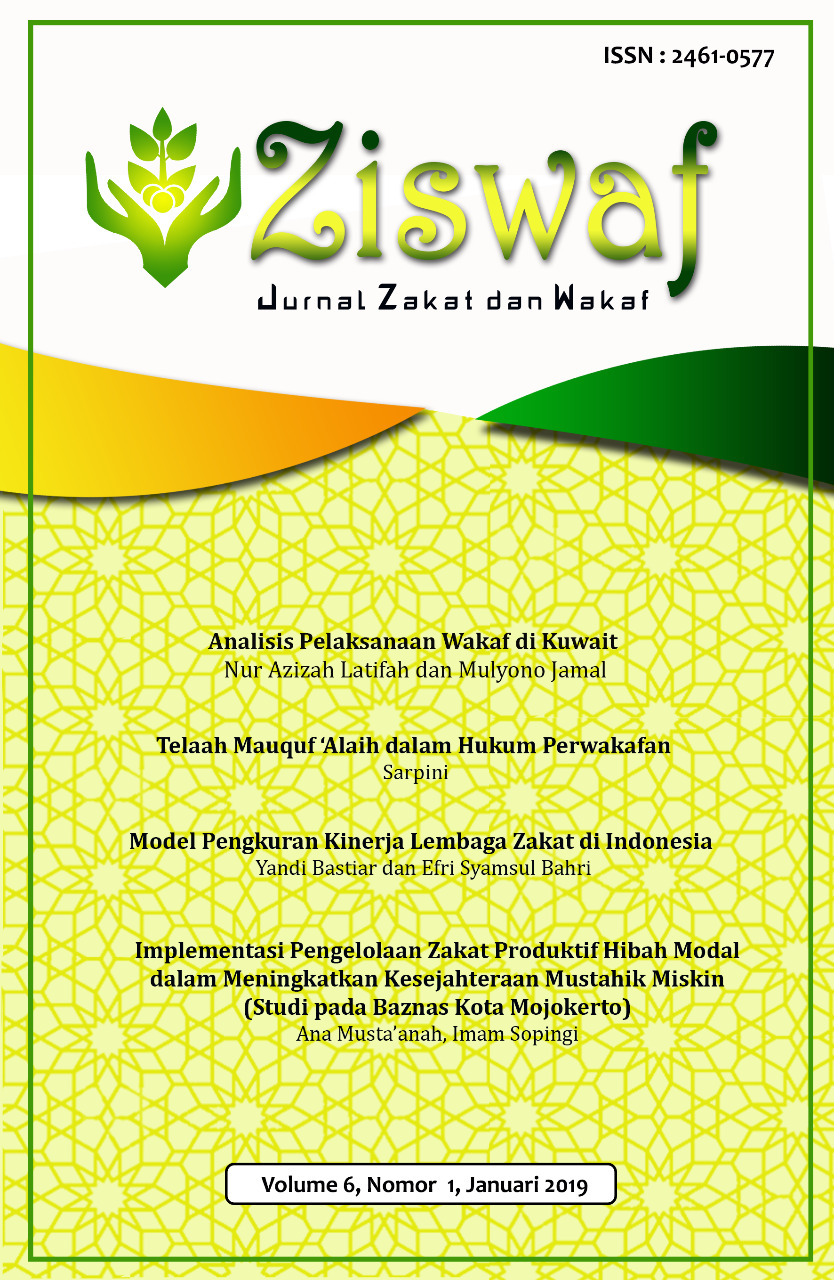




Social Value Creation through Productive Zakat Management by Pesantren Cooperatives: A Case Study of Kopmu-DT Pesantren Daarut Tauhiid
Abstract
This study aims to determine the role of Kopmu-DT in creating social value for beneficiaries, identifying social value creation programs, and analysing the impact of social value creation programs on the welfare of beneficiaries. This approach uses qualitative and case-study designs. The data collection technique was carried out through in-depth interviews, observations, and documentation studies, and the validity of the results was validated using the triangulation technique. Based on the results of the study, it is known that the management of LAZNAS DT Peduli philanthropic funds is productively distributed by Kopmu-DT to its members in the form of initial capital and empowerment facilities. This innovation allows zakat not only to be distributed consumptively, but also managed as sustainable business capital. Social value creation is carried out through Islamic financial services, mentoring, business skills training, and business development support. This program has increased family income, independence as entrepreneurs, and strengthened Islamic values in members' entrepreneurial practices. Thus, this model can be considered an alternative for managing productive zakat to improve community welfare.
Keywords
Full Text:
PDFReferences
Ambo Masse, R., Aderus, A., & Achruh, A. (2024). Social entrepreneurship model in cash waqf: an evidence from Kurir Langit and Dompet Dhuafa. Cogent Arts and Humanities, 11(1). https://doi.org/10.1080/23311983.2024.2418727
Anwar, M. Z., Fathan, Warto, & Hidayati, O. N. (2023). Transformation Of Economic Theology For Community Empowerment A Case Study on Pesantren-Based Bank Wakaf Mikro. Journal of Indonesian Islam, 17(1), 76–99. https://doi.org/10.15642/JIIS.2023.17.1.76-99
Asrofi, M. N., & Sofiah. (2024). Pemberdayaan Ekonomi Masyarakat Melalui Koperasi Pesantren Al-Muta’alimin Desa Karanganyar Kecamatan Ambulu Kabuaten Jember. International Conference on Humanity Education and Sosial, 3(1), 11.
Austin, J., Stevenson, H., & Wei-Skillern, J. (2006). Social and Commercial Entrepreneurship: Same, Different, or Both? Entrepreneurship Theory and Practice, 30(1), 1–22. https://doi.org/ublished January 1, 2006 Rdoi.org/10.1111/j.1540-6520.2006.00107.x
Bashori, A., Mutho’am, M., Arianti, F., Kumala, I. N., Nurviani, E., & Mukarromah, F. L. (2024). The Transformation Of Zakat Law: An Analysis of Ijtihād Maqāṣidī in the Modernisation of Zakat Practices in Indonesia. Jurisdictie: Jurnal Hukum Dan Syariah, 15(1), 34–72.
Baznas. (2021). Pemberdayaan Zakat, Infak, dan Sedekah Berbasis Pesantren. Baznas. https://www.puskasbaznas.com/publications/books/1619-pemberdayaan-zakat-infak-dan-sedekah-berbasis-pesantren
Dali, N. M., & Islam, R. (2018). Prioritization of the indicators and sub-indicators of Maqasid al-Shariah in measuring liveability of cities. International Journal of the Analytic Hierarchy Process, 10(3), 348–371. https://doi.org/10.13033/ijahp.v10i3.597
Dewi, R., Eliyana, A., & Anwar, A. (2022). The role of women entrepreneurship antecedents in supporting social and economic well-being. Problems and Perspectives in Management, 20(2), 438–447. https://doi.org/10.21511/ppm.20(2).2022.36
dt Peduli. (2023). Sejarah Yayasan Daarut Tauhiid Peduli. Yayasan DdtPeduli. https://dtpeduli.org/tentang-kami/sejarah
Ebrahimi, R., Choobchian, S., Farhadian, H., Goli, I., Farmandeh, E., & Azadi, H. (2022). Investigating the effect of vocational education and training on rural women’s empowerment. Humanities and Social Sciences Communications, 9(1). https://doi.org/10.1057/s41599-022-01187-4
Efendi, M. (2017). Pengelolaan Zakat Produktif Berwawasan Kewirausahaan Sosial dalam Pengentasan Kemiskinan Di Indonesia. Al-Hakam, 2 No 1, 15. https://ejournal.iainsurakarta.ac.id/index.php/al-ahkam/article/view/679
Fathoni, M. A., & Rohim, A. N. (2019). Peran pesantren dalam pemberdayaan ekonomi umat di Indonesia. Conference on Islamic Management, Accounting, and Economics (CIMAE) , 2, 133–140.
Hariyati, D. R., Irawan, A. W., & Rikantasari, S. (2022). Model Kewirausahaan Sosial Di Pondok Pesantren Miftahul Hikmah Sukorejo Parengan Tuban. Akademika, Vol. 16(No. 2), 56–72.
Haryati, T. (2023). Model Strategi Pengembangan Kewirausahaan Perempuan Yang Berkelanjutan Di Era Digital. Institut Pertanian Bogor.
Henegar, D., Ilieș, G. L., Mureșan, I. C., Poruțiu, A. R., Arion, I. D., & Arion, F. H. (2024). Customers’ Perception of Microfinance Services as a Tool for Rural Development: A Romanian Case Study. Agriculture (Switzerland), 14(7), 1–19. https://doi.org/10.3390/agriculture14071087
Kamaludin, M. F., Xavier, J. A., & Amin, M. (2021). Social Entrepreneurship and Sustainability: A Conceptual Framework. Journal of Social Entrepreneurship, 0(0), 1–24. https://doi.org/10.1080/19420676.2021.1900339
Kemenag. (2022). Program Kemandirian Pesantren Ramai Peminat. Kemenag. https://www.kemenag.go.id/read/program-kemandirian-pesantren-ramai-peminat-kvn2n
Lorenzo-Afable, D., Lips-Wiersma, M., & Singh, S. (2020). ‘Social’ value creation as care: the perspective of beneficiaries in social entrepreneurship. Social Enterprise Journal, 16(3), 339–360. https://doi.org/10.1108/SEJ-11-2019-0082
Lorenzo-Afable, D., Lips-Wiersma, M., & Singh, S. (2023). A Narrative Synthesis of The Empirical Literature on Social Value Creation in Social Entrepreneurship: Gaps and Opportunities for Future Research and Action. Journal of Social Entrepreneurship, 0(0), 1–32. https://doi.org/10.1080/19420676.2023.2195868
Maclean, M., Harvey, C., Price, M., & Harlow, V. (2025). Social entrepreneurship and the social economy of Victorian and Edwardian Britain. Business History, 0(0), 1–27. https://doi.org/10.1080/00076791.2024.2447268
Mair, J., & Martí, I. (2006). Social entrepreneurship research: A source of explanation, prediction, and delight. Journal of World Business, 41(1), 36–44. https://doi.org/10.1016/j.jwb.2005.09.002
Mengstie, B. (2022). Impact of microfinance on women’s economic empowerment. Journal of Innovation and Entrepreneurship, 11(1). https://doi.org/10.1186/s13731-022-00250-3
Miles, M. B., Huberman, A. M., & Saldana, J. (2014). Qualitative Data Analysis: a Method Sourcebook (3rd ed.). SAGE Publications, Inc.
Moleong, L. (2005). Metodologi Penelitian Kualitatif. Remaja Rodakarya.
Ridwan, M., Andriyanto, I., & Suharso, P. (2019). The BAZNAS Strategy in Coastal Region Economic Empowerment. IOP Conference Series: Earth and Environmental Science, 246(1). https://doi.org/10.1088/1755-1315/246/1/012073
Rozalinda, R., & Nurhasnah, N. (2020). Bank Wakaf Mikro: The Operations and Its Role Towards Muslim Community Economic Empowerment in Islamic Boarding School. Islam Realitas: Journal of Islamic & Social Studies, 6(1), 42. https://doi.org/10.30983/islam_realitas.v6i1.3119
Sandra, Y., & Apriliantoni. (2025). Instrumen Keuangan Syari’ah Dan Merdeka Dari Rentenir. FAWAID: Jurnal Ekonomi Islam, 1(1), 19–30.
Sherraden, M. (2006). Aset Untuk Orang Miskin Perspektif Baru Usaha Pengentasan Kemiskinan (Kusmana (ed.)). PT Rajagrafindo Persada.
Silvana, M., & Lubis, D. (2021). Faktor yang Memengaruhi Kemandirian Ekonomi Pesantren (Studi Pesantren Al-Ittifaq Bandung). AL-MUZARA’AH, 9(2), 129–146. https://doi.org/10.29244/jam.9.2.129-146
Siregar, F. R., Syahbudi, M., & Ilhamy Nasution, M. L. (2024). The Impact of Zakat Utilization and Business Financing on Welfare with Business Sustainability as a Moderating Variable: A Case Study of BAZNAS Labuhanbatu Utara. Jurnal Ilmiah Mizani, 11(2), 363–377. https://doi.org/10.29300/mzn.v11i2.4444
Soetji, A. (2020). Peran Pekerja Sosial Dalam Pendampingan Sosial. Sosio Informa, 6(1), 5–24.
Suryanto, A., Rahmat, B. Z., & Marlina, L. (2020). Islamic Philanthropy : Waqf Empowerment of Madina Minimarket In Tasikmalaya - Indonesia. Ikonomika, 5(1), 1–16. https://doi.org/10.24042/febi.v5i2.5315
Wahyudi, M., & Muna, N. El. (2025). Social Entrepreneurship Integration for Productive Zakat Empirical Study of Program Desa Berdaya Rumah Zakat Indonesia. IJIEFER, 8(1), 18–33.
Widiastuti, T., Al-shami, S. A., Mawardi, I., Zulaikha, S., Haron, R., Kasri, R. A., Mustofa, M. U. Al, & Dewi, E. P. (2024). Capturing the barriers and strategic solutions for women empowerment: Delphy analytical network process. Journal of Open Innovation: Technology, Market, and Complexity, 10(3), 100345. https://doi.org/10.1016/j.joitmc.2024.100345
Widiastuti, T., Auwalin, I., Rani, L. N., & Ubaidillah Al Mustofa, M. (2021). A mediating effect of business growth on zakat empowerment program and mustahiq’s welfare. Cogent Business and Management, 8(1). https://doi.org/10.1080/23311975.2021.1882039
Yin, R. K. (2018). Case Study Research and Applications: Design and Methods (6th ed). Sage Publication, Inc.
Yunus, M. (2008). Menciptakan Dunia Tanpa Kemiskinan (K. Weber (ed.); 1st ed.). Gramedia.
DOI: http://dx.doi.org/10.21043/ziswaf.v13i1.31038
Refbacks
- There are currently no refbacks.
Copyright (c) 2026 ZISWAF: JURNAL ZAKAT DAN WAKAF

This work is licensed under a Creative Commons Attribution-ShareAlike 4.0 International License.
This work is licensed under a Creative Commons Attribution 4.0 International License.