




Integrated Islamic Philanthropy for Equitable Healthcare Access: A Case Study of Muhammadiyah Hospital
Abstract
Keywords
Full Text:
PDFReferences
’Abidin, I. (1994). Radd al-Mukhtar ‘ala al-Dar al-Mukhtar. Dar al-Kutub al-‘Ilmiyah.
Ahmad, G. S., Khan, M. B., Patel, I., Damkar, M. S., & Sharofiddin, A. (2021). Developing the Hybrid Model (Waqf & Zakat) for Improving the Zakat Recipients’ Healthcare in Selangor. Journal of Islamic Finance, 10(1), 67–74.
Ahmed, H. (2004). Role of Zakah and Awqaf in Poverty Alleviation. The Islamic Research and Teaching Institute (IRTI).
Alam, A., Tri Ratnasari, R., Habibi, B., & Hanif Noor Athief, F. (2022). A sharia economic collaboration model and its positive impact on developing of poor villages: A study in Indonesia. Public and Municipal Finance, 11(1), 101–112. https://doi.org/10.21511/pmf.11(1).2022.09
Ali, K. M., Kassim, S., Jannah, M., & Ali, Z. M. (2021). Enhancing The Role of Zakat and Waqf on Social Forestry Program in Indonesia. Economica: Jurnal Ekonomi Islam, 12(1), 1–26.
Al-Zuhaili, W. (1996). Al-Washaya wa al-Waqf fi al-Fiqh al-Islami. Dar al-Fikr.
Ananzeh, H. (2023). The economic consequence of corporate philanthropic donations: Evidence from Jordan. Journal of Business and Socio-Economic Development, 4(1), 37–48. https://doi.org/10.1108/JBSED-10-2022-0112
Ascarya. (2018). Baitul Maal Wat Tamwil (BMT): An Integrated Islamic Social and Commercial Financial Institution in Indonesia.
Ascarya, A., Sukmana, R., Rahmawati, S., & Masrifah, A. R. (2023). Developing Cash Waqf Models for Baitul Maal Wat Tamwil as Integrated Islamic Social and Commercial Microfinance. Journal of Islamic Accounting and Business Research, 14(5), 699–717. https://doi.org/10.1108/JIABR-09-2020-0267
Carroll, A. B. (1991). The Pyramid of Corporate Social Responsibility: Toward the Moral Management of Organizational Stakeholders. Business Horizons, 34(4), 39–48. https://doi.org/10.1016/0007-6813(91)90005-G
Chetioui, Y., Satt, H., Lebdaoui, H., Baijou, M., Dassouli, S., & Katona, S. (2023). Antecedents of Giving Charitable Donations (sadaqah) During the Covid-19 Pandemic: Does Islamic Religiosity Matter? Journal of Islamic Marketing, 14(5), 1169–1187. https://doi.org/10.1108/JIMA-09-2021-0296
Ghaouri, M. H., Kassim, S., Abdullah Othman, A. H., & Zakariyah, H. (2023). Behavioural Intention of Zakat Participants Towards the Zakat Fund in Morocco. ISRA International Journal of Islamic Finance, 15(1), 36–53. https://doi.org/10.55188/ijif.v15i1.484
Hariyanto, E., Taufiq, M., Abidin, Z., Ulum, M., & Maimun. (2020). Effectiveness of the economic system to Zakat and Waqf for empowerment of the Ummah in Indonesia. International Journal of Advanced Science and Technology, 29(6), 1910–1916.
Hasan, R., Ahmad, A. U. F., & Bt. Siraj, S. A. (2022). Building Trust in Waqf Management—Implications of Good Governance and Transparent Reporting. The Singapore Economic Review, 67(01), 459–475. https://doi.org/10.1142/S0217590820420059
Hassanain, K. M. (2015). Integrating Zakah, Awqaf and IMF for Poverty Alleviation: Three Models of Islamic Micro Finance. Journal of Economic and Social Thought, 02(03), 193–211. http://dx.doi.org/10.1453/jest.v2i3.394
Hayati, K. (2015). Zakat Potential As a Means To Overcome Poverty (a Study in Lampung). Journal of Indonesian Economy and Business, 26(2), 187–200. https://doi.org/10.22146/jieb.6270
Herianingrum, S., Ernayani, R., Seto, H., Rayandono, M. N. H., & Fauzy, M. Q. (2020). The Impact of Zakat, Education Expenditure, and Health Expenditure Towards Poverty Reduction. Systematic Reviews in Pharmacy, 11(12), 235–239. https://doi.org/10.31838/srp.2020.12.37
Herianingrum, S., Supriani, I., Sukmana, R., Effendie, E., Widiastuti, T., Fauzi, Q., & Shofawati, A. (2023). Zakat as an instrument of poverty reduction in Indonesia. Journal of Islamic Accounting and Business Research. https://doi.org/10.1108/JIABR-11-2021-0307
Indrawan, I. W., & Herman, S. (2018). Integrated Zakat and Waqf Model for Refugees (IZWMR), Proposal to Improve Livelihood of Global Refugees.
Jatmiko, W., Haidlir, B. M., Azizon, A., Laksmono, B. S., & Kasri, R. (2023). Intergenerational Analysis of Cash Waqf Behavior: Lessons Learned from Indonesia. Journal of Islamic Accounting and Business Research, ahead-of-print(ahead-of-print). https://doi.org/10.1108/JIABR-03-2022-0086
Kabir, H. M. (2010). An Integrated Poverty Alleviation Model Combining Zakat, Awqaf And Micro-Finance. Seventh International Conference – The Tawhidi Epistemology: Zakat and Waqf Economy.
Kahf, M. (1995). Telaah Analitik terhadap Fungsi Sistem ekonomi Islam. Pustaka Pelajar.
Kailani, N., & Slama, M. (2020). Accelerating Islamic Charities in Indonesia: Zakat, Sedekah and the Immediacy of Social Media. South East Asia Research, 28(1), 70–86. https://doi.org/10.1080/0967828X.2019.1691939
Kasdi, A., Karim, A., Farida, U., & Huda, M. (2022). Development of Waqf in the Middle East and its Role in Pioneering Contemporary Islamic Civilization: A Historical Approach. Journal of Islamic Thought and Civilization, 12(1), 186–198. https://doi.org/10.32350/jitc.121.10
Kholifah, A., Sholiqah, N., Asadanie, F. K., Khoirunnisa, R., Lusananta, D. T., & Asyrofi, M. (2021). Potensi Wakaf Tunai Sebagai Instrumen Keuangan Publik Islam Dalam Meningkatkan Kesejahteraan Umat. In D. E. Restiani (Ed.), Zakat, Wakaf, Hingga Sukuk. CV Jejak.
Koleva, P. (2021). Towards the Development of an Empirical Model for Islamic Corporate Social Responsibility: Evidence from the Middle East. Journal of Business Ethics, 171(4), 789–813. https://doi.org/10.1007/s10551-020-04465-w
Lestari, T. R. P. (2010). Pelayanan Rumah Sakit bagi Masyarakat Miskin (Studi Kasus di Enam Wilayah Indonesia). Kesmas Jurnal Kesehatan Masyarakat Nasional, 5(1), 9–16.
Lita, H. N. (2021). Waqf And Economic Distribution Justice: Sustainable Poverty Alleviation Efforts. Journal of Legal, Ethical and Regulatory Issues, 24(Special Issue 1), 1–6.
Makhrus. (2018). Dinamika Dan Aktivisme Filantropi Islam Dalam Pemberdayaan Masyarakat. Litera.
Masrizal, M., Sukmana, R., Trianto, B., & Zaimsyah, A. M. (2023). Determinant Factor of Crowdfunders’ Behavior in Using Crowdfunding Waqf Model in Indonesia: Two Competing Models. Journal of Islamic Marketing, 14(7), 1793–1816. https://doi.org/10.1108/JIMA-08-2021-0246
Mawardi, I., Widiastuti, T., Al Mustofa, M. U., & Hakimi, F. (2022). Analyzing the impact of productive zakat on the welfare of zakat recipients. Journal of Islamic Accounting and Business Research. https://doi.org/10.1108/JIABR-05-2021-0145/FULL/HTML
Nour Aldeen, K., Ratih, I. S., & Sari Pertiwi, R. (2022). Cash waqf from the millennials’ perspective: A case of Indonesia. ISRA International Journal of Islamic Finance, 14(1), 20–37. https://doi.org/10.1108/IJIF-10-2020-0223
Novita, I., & Nidia, Z. (n.d.). Sri Mulyani: Potensi Wakaf di Indonesia Rp 217 Triliun. Republika, 2020.
Razak, S. H. A. (2020). Zakat and waqf as instrument of Islamic wealth in poverty alleviation and redistribution: Case of Malaysia. International Journal of Sociology and Social Policy, 40(3/4), 249–266. https://doi.org/10.1108/IJSSP-11-2018-0208
Rimpeng, L. (2022). Zakat, Islamic Virtues, and Social Justice: A Case of the Chiang Mai Zakat (Bayt al-Māl) Fund in Chiang Mai Province of Thailand. Al-Jami’ah: Journal of Islamic Studies, 60(2), 347–372. https://doi.org/10.14421/ajis.2022.602.347-372
Rizal, A., Fauziyah, N. E., Ma’ruf, A., & Susilo, A. (2020). Integrating Zakah and Waqf for Developing Islamic Economic Boarding School (iebs) Project in Indonesia. Journal of Islamic Economics and Philanthropy, 3(02).
Rizal, R., Ghofur, R. A., & Utami, P. (2023). The Role of Muslim Generation Community at Zakat Collection on Realizing Sustainable Development Goals (SDGs) in the Era of Digital Society 5.0. JURIS (Jurnal Ilmiah Syariah), 22(1), 105. https://doi.org/10.31958/juris.v22i1.6562
Rozalinda. (2015). Manajemen Wakaf Produktif. Rajawali Pers.
Roziq, A., Yulinartati, & Yuliarti, N. C. (2022). Model of Productive Islamic Social Fund Management for Poor Empowerment. International Journal of Professional Business Review, 7(5), e0597. https://doi.org/10.26668/businessreview/2022.v7i5.e597
Safutra, I. (2021). Potensi Dana Zakat Rp 327,6 T, Realisasi Baru Rp 71,4 T. Jawa Pos.
Setiyowati, A. (2019). Empowering islamic philanthropy: Analysis of entrepreneurial capital assistance program by lazismu surabaya city. Humanities and Social Sciences Reviews, 7(4), 1018–1025. https://doi.org/10.18510/hssr.2019.74139
Shirazi, N. S. (2014). Integrating Zakat and Waqf into the Poverty Reduction Strategy of the IDB Member Countries. Islamic Economic Studies, 22(1), 79–108. https://doi.org/10.12816/0004131
Sodikin, A. (2020). Belajar dari Kasus Balita Rafadan, Orang Miskin Dilarang Sakit? Kompas. https://regional.kompas.com/read/2020/07/06/23300061/belajar-dari-kasus-balita-rafadan-orang-miskin-dilarang-sakit?page=all
Sulistyowati, S. (2018). Designing integrated zakat-waqf models for disaster management. Journal of Islamic Monetary Economics and Finance, 4(2), 347–368.
Widiastuti, T., Ningsih, S., Prasetyo, A., Mawardi, I., Herianingrum, S., Robani, A., Al Mustofa, M. U., & Hady, A. F. (2022). Developing an integrated model of Islamic social finance: Toward an effective governance framework. Heliyon, 8(9), e10383. https://doi.org/10.1016/j.heliyon.2022.e10383
Zaenal, M. H., Astuti, A. D., Choirin, M., & Sadariyah, A. S. (2017). Integrating Zakat and Waqf Project: A Case Study of Free Hospital Development of the National Zakat Board (BAZNAS) Indonesia. Puskas Working Paper Series PWPS.
Zahri, Mohd. ‘Adli, Muhd Adnan, N. I., Irfan, I., & Mohd Kashim, M. I. A. (2023). Microfinancing from the Zakat Fund in Baitul Mal Aceh and the Readiness of Malaysia’s Asnaf Entreprenuers. Samarah: Jurnal Hukum Keluarga Dan Hukum Islam, 7(1), 418. https://doi.org/10.22373/sjhk.v7i1.16012
Zarfi, A. (2019). The integration of Awqaf, Zakat and Crowdfunding in Islamic Microfinance Framework: Focus on Moroccan case. Recherches et Applications En Finance Islamique (RAFI), 3(1), 43–57. https://doi.org/10.48394/IMIST.PRSM/rafi-v3i1.14613
DOI: http://dx.doi.org/10.21043/ziswaf.v12i2.32614
Refbacks
- There are currently no refbacks.
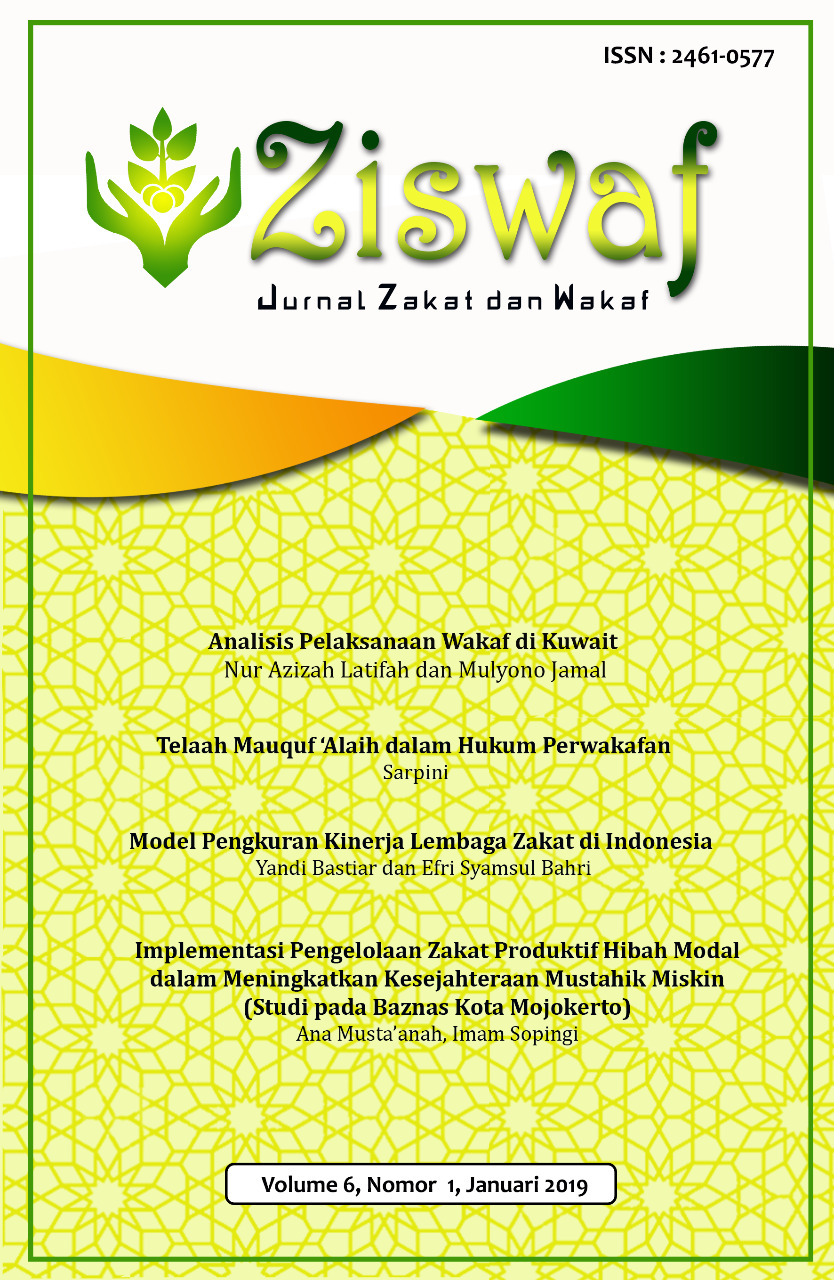
Copyright (c) 2025 ZISWAF: JURNAL ZAKAT DAN WAKAF

This work is licensed under a Creative Commons Attribution-ShareAlike 4.0 International License.
This work is licensed under a Creative Commons Attribution 4.0 International License.